


There is a moment in many leadership searches when everything seems to align.
The candidate communicates well.
The experience matches the role.
The interviews feel smooth.
And yet, some of the most expensive leadership mismatches begin exactly there — in moments of apparent certainty.
Not because the interviews were poorly run.
But because interviews alone tend to amplify confidence, not clarity.
When “everything feels right” becomes a risk
Interview processes are designed to surface strengths. That’s their nature.
Senior leaders are often skilled at presenting coherent narratives, especially in high-stakes conversations. Over time, this can create a subtle illusion: clarity through consistency. When answers flow easily, we assume alignment.
But leadership success rarely depends on how well someone explains their past.
It depends on how they interpret ambiguity, handle tension, and make decisions when signals conflict.
These qualities are harder to observe — and easier to miss — when interviews become the primary decision lens.
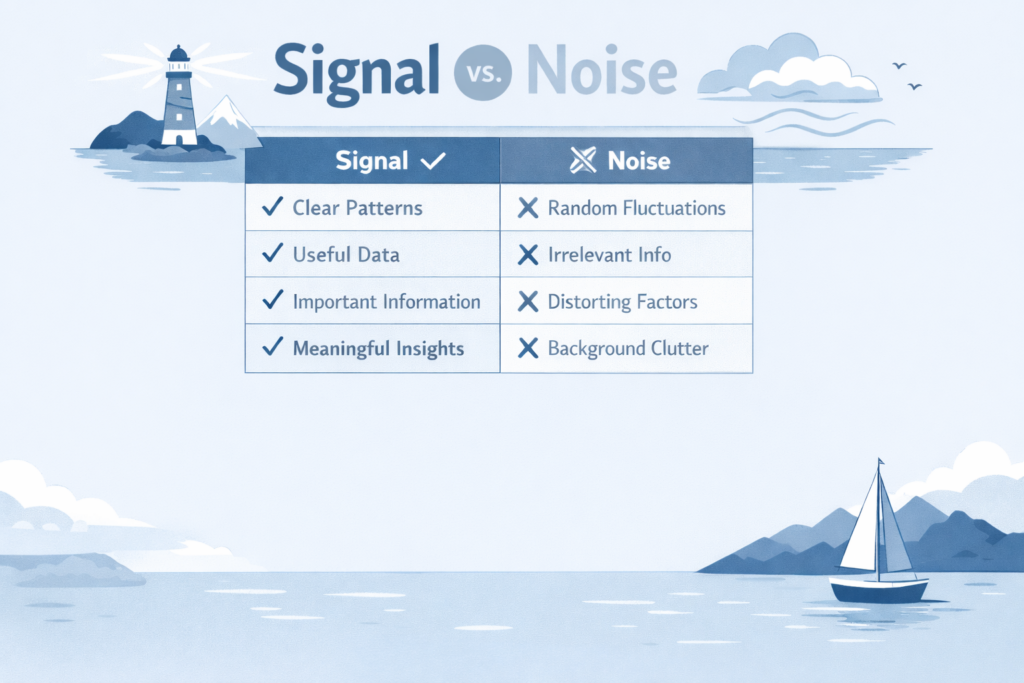
Signal vs noise in leadership assessment
One pattern we see repeatedly across leadership searches is decision teams reacting to noise rather than signal.
Noise often sounds like:
- strong storytelling
- polished frameworks
- confident agreement with stated values
Signals tend to appear elsewhere:
- how a leader speaks about uncertainty
- where responsibility is placed when outcomes fall short
- how decisions that didn’t work are described
- in difficulties true culture emerges: either the ones to blame are found or ways to improve are discussed
The challenge is rarely a lack of information.
It is distinguishing what actually predicts leadership effectiveness from what simply feels reassuring.
How decision-makers create real clarity
Improving decision quality does not require longer processes or more interviews.
It requires better questions.
Questions that move the conversation away from what a leader has done toward how they think, decide, and adapt under pressure.
When organisations slow down just enough to explore these dimensions, something important happens:
confidence becomes grounded, not performative.
7 Questions That Reveal Real Leadership Fit
- What decision are you most uncertain about right now — and why?
Reveals comfort with ambiguity and self-awareness. - Which leadership belief did you have to unlearn?
Shows adaptability beyond success stories. - Where have you misread an organisation — and what did it cost?
Surfaces cultural intelligence. - Who challenges your decisions, and how do you respond?
Highlights power dynamics and openness. - What pressure tends to narrow your thinking?
Reveals stress patterns before they surface in the role. - What did your last team need more from you — and less?
Signals relational maturity. - What would success in this role require you to do differently?
Tests readiness for change, not repetition.
These questions are not designed to trap candidates.
They are designed to replace assumptions with understanding.
They are also not always easy to ask — often not for candidates, but for decision-makers.
Closing reflection
Strong leadership decisions are rarely about finding perfect answers.
They are about asking questions that introduce clarity where certainty feels too easy.
If interviews feel “too smooth,” it may be worth asking whether enough signal has actually been revealed.
Smooth processes rarely reveal real leadership.
Pressure does.
If this topic resonates, happy to exchange notes.
Source: Authoritative hiring/leadership decision source ( Harvard Business Review)